< What's New
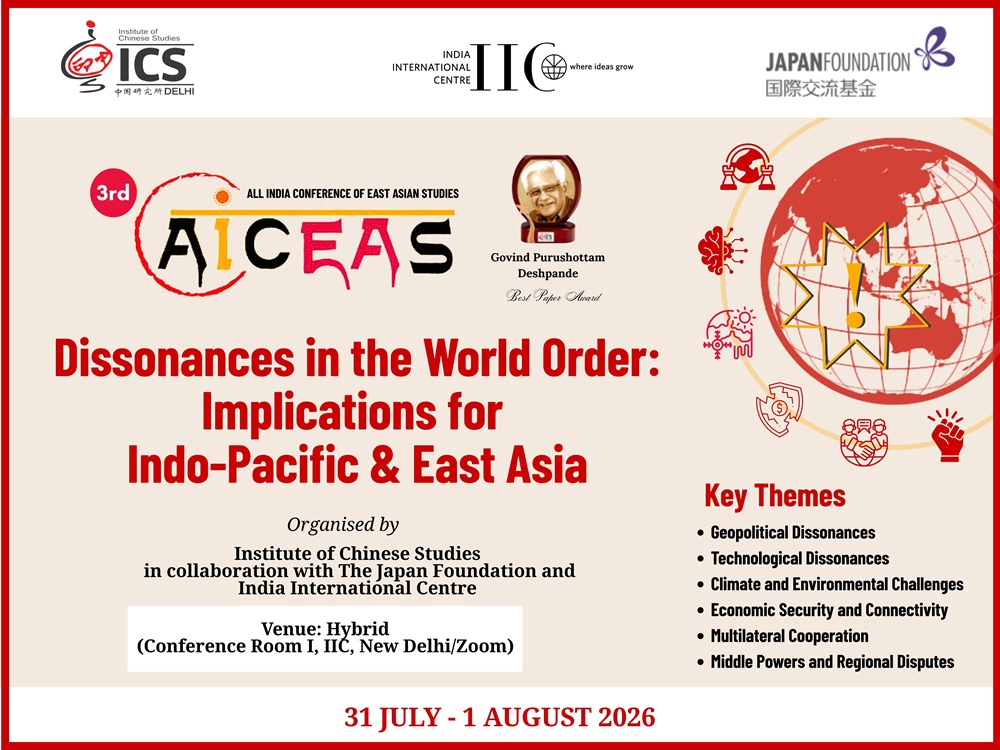
Dissonances in the World Order: Implications for Indo-Pacific and East Asia
CONCEPT NOTE
The rule-based order has faced a gradual yet marked erosion since the end of the Cold War in 1991. The US-dominated order in East Asia and the wider Indo-Pacific region, as represented by the post-World War II “hub-and-spokes” system of multilateralism through bilateralism, has been challenged by the rise of China over the last three decades. The consequent incremental great power rivalry has had a spill over effect in the region, causing dissonances and undermining stability in the Indo-Pacific region.
Nations such as Japan, the Republic of Korea, and the Philippines, despite being middle powers and US allies, have been pushed to balance between the US and China, while enhancing their defence capabilities and economic security. As geopolitical tensions rise, economic security has emerged as a central concern, with supply chains becoming strategic vulnerabilities and shifting alignments, especially in critical sectors such as semiconductors, rare earths, and energy. Furthermore, China’s growing engagement with ASEAN has prompted Japan and Korea to pursue initiatives to secure investments and trade routes.
Japan’s vision of a “Free and Open Indo-Pacific” (FOIP) stands as a counterbalance to coercive economic and strategic practices. This vision emphasises the rule of law, freedom of navigation, economic connectivity, and respect for sovereignty. Japan, through its diplomacy, development partnerships, and climate initiatives, continues to play a pivotal role in setting standards for transparent and sustainable regional engagement.
Bringing the Indo-Pacific to the centre stage has led to the proliferation of security-based institutions such as the QUAD, SQUAD, and AUKUS, as well as economic frameworks such as the Asia-Pacific Economic Cooperation (APEC), Regional Comprehensive Economic Partnership (RCEP), and the Comprehensive and Progressive Agreement for Trans-Pacific Partnership (CPTPP), further adding to regional complexity. At the intersection of regional and economic security lies Taiwan, whose future directly affects the continued existence of the rule-based order in East Asia and the Indo-Pacific. In this dynamic and complex milieu, Japan stands as a central pillar, playing a significant role in regional and economic security, especially through initiatives such as ODA and OSA, and in institutional engagement.
The 3rd All India Conference of East Asian Studies, to be held from 31 July- 1 August 2026, will focus on the region's pressing challenges. Japan, as a nation, has strong concerns about keeping the Indo-Pacific free and open and has countered Chinese initiatives through its own diplomatic policies. This conference aims to spend a day reflecting on how Japan has operated in the rapidly evolving, disruptive world and on the role it can play in shaping this region. On day two, the agenda will be to look at other East Asian nations’ ongoing efforts to address these challenges and how cooperation and competition between nations directly shape the regional order.
Key Themes for Discussion
Expected Outcomes
Enhanced understanding of Japan and Korea’s role in shaping Indo-Pacific stability
Policy-relevant insights into managing disruption without escalation
Identification of cooperative pathways for regional and extra-regional actors
Contribution to academic and policy debates on Indo-Pacific governance
CALL FOR PAPERS
The Institute of Chinese Studies (ICS) is pleased to announce the 3rd All India Conference of East Asian Studies (AICEAS). Since 2022, the ICS has held AICEAS in partnership with leading academic institutions/ research organisations across India. The conference is convened bi-annually. The 1st AICEAS was held in collaboration with the Department of International Relations & Governance Studies (IRGS), Shiv Nadar University (Delhi NCR) from 21-22 March 2022. The 2nd AICEAS was held in collaboration with the Centre for East Asian Studies, Christ University from 5-6 April 2024.
AICEAS brings together students, researchers, university faculty, practitioners and other individuals with an interest in East Asia to present and discuss their research in the field. The principal objective of the conference is to foster interest in and strengthen research on East Asian Studies, primarily focusing on Japan, South Korea, North Korea, Mongolia and Taiwan. We also welcome papers related to Southeast Asia. As mentioned above, this year, the theme of the conference is Dissonances in the World Order: Implications for Indo-Pacific and East Asia.
The Deadlines are:
10 June 2026 : Last date for receiving extended abstracts (2000 words)
30 June 2026 : Notification of shortlisted abstracts
31 July - 1 August 2026 : Conference
Please submit your extended abstracts to aiceas.ics@gmail.com. If you have any queries or concerns, please write to us at aiceas.ics@gmail.com.
The best overall paper presented by a young & emerging scholar at AICEAS will be selected for the Govind Purushottam Deshpande Award with a prize money of Rs. 25,000/-. The selections will be made by a committee of scholars and eminent experts, set up by the ICS on the basis of methodology, sources consulted, arguments and presentation. Further relevant information will be posted in due course of time on the ICS website.
Convener
Prof. Srabani Roy Choudhury
Professor, Japanese Division
Centre for East Asian Studies
School of International Studies
Jawaharlal Nehru University
Adjunct Fellow
Institute of Chinese Studies
New Delhi
Co-Convener
Prof. Sandip Mishra
Professor, Korean Division
Centre for East Asian Studies
School of International Studies
Jawaharlal Nehru University
Honorary Fellow
Institute of Chinese Studies
New Delhi
 Programme Schedule
Brochure
Programme Schedule
Brochure


© 2019 ICS All rights reserved.
Powered by Matrix Nodes
 Book Your Calendar