< What's New
Events > Giri Deshingkar Memorial Lecture
Abstract
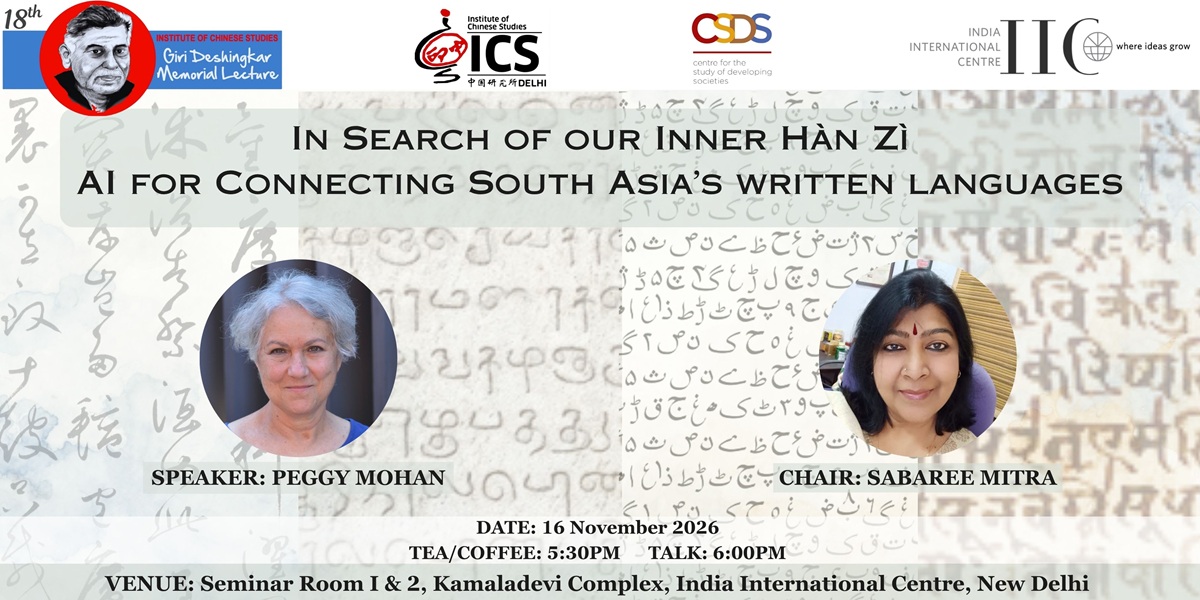
India and China are old civilizations which share many milestones in their historical journeys, where we have faced similar questions and choices. Three thousand years ago, we opted to keep the earliest text, the Rig Veda, unwritten, relying on memorisation to keep it preserved. At that same time China began to experiment with writing, using characters that were indifferent to the sounds and vocabulary of their languages, seeing them all as simply ‘dialects’ of Chinese. Later, India’s modern languages chose to emphasise their diversity by opting for phonetic writing systems that spotlighted their differences, even coming up with a different script for each language. But underneath it all, in their basic operating systems, Indian languages and Chinese ‘dialects’ have always had highly similar levels of diversity. Ancient substrata in both Indian and Chinese languages show an areal spread of shared notions of grammar and word order. It is unfeasible for South Asia to undo this division by switching to using characters, but AI can step up to connect all our written languages, indifferent to their vocabulary, sounds and writing systems. Like Hàn Zì it would simply by pass these areas of diversity and let us connect at the level of meaning. Both India and China understood, in 1947 and 1949, that we needed mass literacy to build modern societies. But in India the absence of a single local language of science and technology has sustained the English language that nearly 80 percent of the population does not know. The exclusion of these Indians from the conversation about the future has made us a nation not ‘firing on all cylinders’. With AI translation, we have a chance to find our ‘Inner Hàn Zì’ and simultaneously connect all our languages, preserving our diversity and giving place to all our people.
Speaker
Peggy Mohan completed her PhD in linguistics from the University of Michigan in 1978. She has taught linguistics at Howard University, Washington D.C., Jawaharlal Nehru University and Ashoka University, and mass communications at Jamia Millia Islamia, New Delhi. She is the author of three novels, Jahajin, The Youngest Suspect and Walk in C Minor, and the non-fiction books Wanderers, Kings, Merchants, (Penguin Random House 2021) which won the Mathrubhumi Book of the Year Award, and Father Tongue, Motherland (Penguin Random House 2025) which won the Sarvepalli Radhakrishnan Award for Non-Fiction, as well as her latest book on language in India, Framing The Future, released by Penguin Random House in October 2026
Chair
Sabaree Mitra is a Professor of Chinese in Jawaharlal Nehru University and an Honorary Fellow at the Institute of Chinese Studies, New Delhi. Her teaching and research have spanned the fields of contemporary Chinese literature and criticism, Chinese cultural history, gender issues, India-China cultural relations and regional interaction. Her latest publication is, an edited volume titled China’s May Fourth Movement: New Narratives and Perspectives, published by Routledge in 2023. She is also the Editor of the ICS quarterly journal, China Report, published by Sage. Her co-edited volume (with Usha Chandan) in honour of Prof. Patricia Uberoi, titled China's Society and Culture: Studies and Reflections was released on October 2, 2026
Lecture details and guidelines
This event is being organised in collaboration with the India International Centre (IIC), with the Centre for the Study of Developing Societies (CSDS) as its partner. The lecture will be preceded by tea at 5:30 PM IST in front of the hall.
© 2019 ICS All rights reserved.
Powered by Matrix Nodes
 Book Your Calendar